I was awakened a little after 6 AM this morning by the sound of a downpour on the roof of Auntie Violet. Now, we used to have a metal roof on one of the porches in our house in Spokane that was right outside our upstairs bedroom window. And I enjoyed the sound of the rain on that roof -- mainly because I didn't hear it very often!
The rain tapered off a bit while we were getting everything disconnected so that we could move this morning. Still, we got quite wet while we were disconnected the water and electricity. We didn't have terribly far to go. It's a pretty short drive from Bowling Green, Kentucky to Nashville, Tennessee. It's a straight shot down I-65.
As you can see, it was a gray day for traveling --
We're staying at an RV Park, Nashville Country RV Park, in a northern suburb of Nashville called Goodlettsville. Our friends, Juni and Tom, will arrive tomorrow.
We got here early enough to make a much needed Costco run (of course, clear on the other side of Nashville!). I bought some great blue crab dip and lobster dip from Gold Coast in Naples, Florida to use for appetizers the next couple of days. When I asked why we never saw either of these at our local Costcos, I was told that they don't freeze them, so only sell them in the southeast. At least, Forry got his favorite gourmet meal -- a Costco Polish dog!
Showing posts with label Kentucky. Show all posts
Thursday, November 3, 2011
Wednesday, November 2, 2011
Corvettes!
We walked over a mile in this building today! This old Chrysler air conditioner plant is now the home of Bowling Green, Kentucky's Corvette Assembly Plant. Every Corvette made today is produced at this plant.
All of the parts that make up a Corvette are delivered here and come out the other side as beautiful new gorgeous Corvettes. Unfortunately, they do not allow cameras -- or even cell phones -- in the plant, so I cannot share any of the neat stuff we saw. They usually run tour groups of 25 people through at a time, but for some reason, today was not a big tour day. There were only 7 of us in our group. I think our guide Marcus enjoyed having a small group of people. We had a very leisurely and informative tour.
Across the road from the Assembly Plant is the National Corvette Museum --
The Museum does allow photography. They not only had many Corvettes on display, but they also had several dioramas showing historic episodes.
All of the sculptures in the dioramas are life-size and solid white --
The museum also had a few General Motors antique vehicles on display. I got a kick out of this early produce vendor's pick-up truck --
After we hiked around the Assembly Plant and then the Museum, we were both pooped. We stopped at a Bob Evans restaurant on the way home for country-fried steaks, then came home and crashed!
All of the parts that make up a Corvette are delivered here and come out the other side as beautiful new gorgeous Corvettes. Unfortunately, they do not allow cameras -- or even cell phones -- in the plant, so I cannot share any of the neat stuff we saw. They usually run tour groups of 25 people through at a time, but for some reason, today was not a big tour day. There were only 7 of us in our group. I think our guide Marcus enjoyed having a small group of people. We had a very leisurely and informative tour.
Across the road from the Assembly Plant is the National Corvette Museum --
The Museum does allow photography. They not only had many Corvettes on display, but they also had several dioramas showing historic episodes.
All of the sculptures in the dioramas are life-size and solid white --
The museum also had a few General Motors antique vehicles on display. I got a kick out of this early produce vendor's pick-up truck --
After we hiked around the Assembly Plant and then the Museum, we were both pooped. We stopped at a Bob Evans restaurant on the way home for country-fried steaks, then came home and crashed!
Monday, October 31, 2011
HAPPY HALLOWEEN!
Happy Halloween to all those ghosts and goblins out there!
We have not seen any trick-or-treaters here at the Bowling Green Kentucky KOA Kampground. One of the reasons we left the Yarwood Mobile Home Park a day early was because of Halloween. Forry's been a bit nervous about that park (though we saw no evidence of vandalism) and really didn't want to borrow trouble by being there for Halloween.
So this morning we took out the garbage (we had our own garbage container furnished by the park) and parked it by the road; drained the gray and black tanks; pulled up the jacks; pulled in the slides; disconnected the water and the power; hitched up the Toad; checked the lights; and headed down the road. We took I-65 south just as we had a couple of days ago when we went to Mammoth Cave. It's interesting how much more you can see from height of the motor home compared to driving it in the Toad.
We had looked at staying at another RV Park advertised in the Bowling Green Visitor's Guide. We called Beech Bend Park several times, but always got their answering machine. Although the message said they would get right back to us, we still haven't heard from them. We are hesitant to drive to an RV Park that may be closed -- getting turned around could be a real problem!
We saw something neat today that we have not seen anywhere else. Bowling Green has ALL of their traffic lights on the main drag numbered (1-20). There is a neat sign by each light saying what number it is. So when you get directions, you can be told to turn at Stoplight 15, for example. No need to count lights like when someone tells you to turn at the third light. And even nicer, the map of Bowling Green has the numbers of the traffic lights on it as well!
Saturday, October 29, 2011
Mammoth Cave & a Civil War Battlefield
Beneath the sandstone and shale ridges of Mammoth Cave National Park lies the most extensive cave system on earth. With over 365 miles of surveyed passage ways, Mammoth Cave is over twice as large as any other known cave. There are eleven different tours of the cave available ranging from one and one-quarter hours to six and one-half hours. They range in difficulty from "Easy" to "Very Strenuous." We chose to take the Mammoth Passage Tour -- one of the "easy" ones!
The trail down to the natural entrance to the cave is quite steep (and seemed even steeper when we climbed back up at the end of the tour!). Here is part of our group of fifteen or so heading down --
The transition from the outside to the dark and the rather low ceiling --
These are cribs where slaves piled cave dirt and guano in the cave to manufacture salt petre (to make black gun powder) during the war of 1812.
Beyond that is an area called the "Rotunda."--
The further we descended into the cavern the darker it got. I was very glad for the handrails put in many years ago by CCC workers, who made the trails.
The group standing in an area of the cave that clearly shows the layers carved out millions? of years ago by water and carbonic acid --
Here is our Park Ranger explaining that this portion of the cave is a "dry" cave with no active water, therefore no stalactites or stalagmite's. Many parts of the cave are still wet and are being still being carved out --
Mammoth Cave has been a tourist attraction since 1816 when tour guides were African-American slaves. It was authorized as a national park in 1926 and fully established in 1941. At that time, only forty miles of passageways had been mapped. The Ranger estimated that there were still more than three hundred miles of passages that have not yet been mapped.
All I know is that I was sure glad to see the light of the entrance as we came back out!
On our way back to Auntie Violet we saw a road sign pointing to "Civil War Battlefield." Since we are in the south, we thought we should at least check one out, so we followed it. It took us to a farmstead which is now the "Battle for the Bridge" battlefield site Historic Preserve. I did not realize that Kentucky had NOT seceded from the Union and joined the Confederacy. They chose to be a slave state, but to remain neutral (both the Union and the Confederacy established capitals in the state...).
The Kentucky railroads proved to be too important to both sides and many battles were fought over control of them. This battle was over control of the railroad bridge that can be seen in the distance from the farmhouse --
The land between the farmstead and the bridge is now in private hands, so you cannot walk over that portion of the battlefield. The Rowland family submitted claims of $12,000 to the government for the damages to their farmland and buildings, but because Rowland was falsely claimed to be a "southern man," they were denied. Eventually, they received a little over $4000 to rebuild their house.
The trail down to the natural entrance to the cave is quite steep (and seemed even steeper when we climbed back up at the end of the tour!). Here is part of our group of fifteen or so heading down --
The transition from the outside to the dark and the rather low ceiling --
These are cribs where slaves piled cave dirt and guano in the cave to manufacture salt petre (to make black gun powder) during the war of 1812.
Beyond that is an area called the "Rotunda."--
The further we descended into the cavern the darker it got. I was very glad for the handrails put in many years ago by CCC workers, who made the trails.
The group standing in an area of the cave that clearly shows the layers carved out millions? of years ago by water and carbonic acid --
Here is our Park Ranger explaining that this portion of the cave is a "dry" cave with no active water, therefore no stalactites or stalagmite's. Many parts of the cave are still wet and are being still being carved out --
Mammoth Cave has been a tourist attraction since 1816 when tour guides were African-American slaves. It was authorized as a national park in 1926 and fully established in 1941. At that time, only forty miles of passageways had been mapped. The Ranger estimated that there were still more than three hundred miles of passages that have not yet been mapped.
All I know is that I was sure glad to see the light of the entrance as we came back out!
On our way back to Auntie Violet we saw a road sign pointing to "Civil War Battlefield." Since we are in the south, we thought we should at least check one out, so we followed it. It took us to a farmstead which is now the "Battle for the Bridge" battlefield site Historic Preserve. I did not realize that Kentucky had NOT seceded from the Union and joined the Confederacy. They chose to be a slave state, but to remain neutral (both the Union and the Confederacy established capitals in the state...).
The Kentucky railroads proved to be too important to both sides and many battles were fought over control of them. This battle was over control of the railroad bridge that can be seen in the distance from the farmhouse --
The land between the farmstead and the bridge is now in private hands, so you cannot walk over that portion of the battlefield. The Rowland family submitted claims of $12,000 to the government for the damages to their farmland and buildings, but because Rowland was falsely claimed to be a "southern man," they were denied. Eventually, they received a little over $4000 to rebuild their house.
Friday, October 28, 2011
Fall in Kentucky
We didn't get as far north as Maine (and are sure glad we didn't with the nor'easter and snow forecast for this weekend!), but we have experienced some glorious color anyway this fall. I took these pictures of the wooded hills during our drive yesterday. It was an overcast, gloomy day. I wonder how bright these colors would have been if the sun were out?
There were a great many trees and shrubs that were orange and red. I can identify the sumacs, but I don't know any of the others...
The part of Kentucky we are in is very hilly. The trees don't appear to be very ancient --
These trees have not yet turned color. They looked almost eerie with the red behind them!
We weren't terribly ambitious today. We went to the post office to pay our Adams County 1/2 taxes and picked up some Priority Mail boxes to send Sister Sherry's birthday present and the Halloween packages to the grand-kids. We got those filled and addressed and took them back to the post office. I fixed a small pork loin with a peach jam glaze and cut up the last of the butternut squash for dinner.
There were a great many trees and shrubs that were orange and red. I can identify the sumacs, but I don't know any of the others...
The part of Kentucky we are in is very hilly. The trees don't appear to be very ancient --
I took the next couple of pictures this evening here at the Yarwood Motor Home Park. The sun was setting behind the trees to the west end of the park --
These trees have not yet turned color. They looked almost eerie with the red behind them!
We weren't terribly ambitious today. We went to the post office to pay our Adams County 1/2 taxes and picked up some Priority Mail boxes to send Sister Sherry's birthday present and the Halloween packages to the grand-kids. We got those filled and addressed and took them back to the post office. I fixed a small pork loin with a peach jam glaze and cut up the last of the butternut squash for dinner.
Labels:
Adams County,
Fall,
Kentucky,
Maine,
nor'easter,
Priority Mail,
Yarwood
Thursday, October 27, 2011
Jim Beam
It rained almost all night again and it was extremely dark and overcast again this morning. I did several loads of laundry, then we decided to check out the Jim Beam Distillery. This one is only about twenty miles from Radcliff. It was a good choice as they do not have a tour of the distillery (though there will be one in 2012), but take you through the warehouses instead. Since we didn't get a chance to see inside a warehouse yesterday, it was a good choice.
Jim Beam is the largest of Kentucky's bourbon distilleries. They said they make over 50% of the world's bourbon. Twenty-seven of their seventy-two warehouses are at this distillery in Clermont which is one of three.
At the beginning of the tour, we were taken to see an 1800 copper still, believed to be one of the oldest in America. In 1788, Jacob Beam and his family settled in what would be known as Kentucky. He began distilling bourbon for his personal use and sold his first barrel in 1795.
The bark of the trees around the distillery all have this deep black color, as do many of the buildings. The color comes from the "angel's portion" of the bourbon -- the evaporation of the liquid through the charred barrels. They said that was one of the ways the revenuers could spot an illegal still --
Jacob's great grand-son, James B. Beam, rebuilt the family distillery by hand after Prohibition ended, and from then on, the bourbon was called Jim Beam. We were taken to Warehouse D, the oldest rack house, which was built by Jim Beam after Prohibition in 1934. It holds 20,000 oak barrels of aging bourbon --
The barrels are placed in "racks," three high and fourteen barrels deep where they will remain for at least four years --
Looking back down the hallway to where we entered the rack house at the racks of barrels on either side --
And then looking up -- fourteen stories!
Each barrel is stamped on the end with numbers and letters that identify the contents and when it was barreled. The liquor begins to be taxed from the moment it is poured into the barrel and is taxed every year for the next four to twelve years or however long it is aged. They told us that 3/4 of the cost of bourbon is tax.
Outside on the grounds is this statue of Booker Noe, Master Distiller, enjoying a glass of his own product along with his dog, Dot.
This is the Beam family home where three generations of distillers oversaw the distilling of the family's bourbon --
At the Jim Beam Tasting Room, we were each given a taste of Black Label Jim Beam and of one of their Small Batch Bourbons, Baker's. The Baker's was served with bourbon chocolates. Yummy!
Jim Beam is the largest of Kentucky's bourbon distilleries. They said they make over 50% of the world's bourbon. Twenty-seven of their seventy-two warehouses are at this distillery in Clermont which is one of three.
At the beginning of the tour, we were taken to see an 1800 copper still, believed to be one of the oldest in America. In 1788, Jacob Beam and his family settled in what would be known as Kentucky. He began distilling bourbon for his personal use and sold his first barrel in 1795.
The bark of the trees around the distillery all have this deep black color, as do many of the buildings. The color comes from the "angel's portion" of the bourbon -- the evaporation of the liquid through the charred barrels. They said that was one of the ways the revenuers could spot an illegal still --
Jacob's great grand-son, James B. Beam, rebuilt the family distillery by hand after Prohibition ended, and from then on, the bourbon was called Jim Beam. We were taken to Warehouse D, the oldest rack house, which was built by Jim Beam after Prohibition in 1934. It holds 20,000 oak barrels of aging bourbon --
The barrels are placed in "racks," three high and fourteen barrels deep where they will remain for at least four years --
Looking back down the hallway to where we entered the rack house at the racks of barrels on either side --
And then looking up -- fourteen stories!
Each barrel is stamped on the end with numbers and letters that identify the contents and when it was barreled. The liquor begins to be taxed from the moment it is poured into the barrel and is taxed every year for the next four to twelve years or however long it is aged. They told us that 3/4 of the cost of bourbon is tax.
Outside on the grounds is this statue of Booker Noe, Master Distiller, enjoying a glass of his own product along with his dog, Dot.
This is the Beam family home where three generations of distillers oversaw the distilling of the family's bourbon --
At the Jim Beam Tasting Room, we were each given a taste of Black Label Jim Beam and of one of their Small Batch Bourbons, Baker's. The Baker's was served with bourbon chocolates. Yummy!
Wednesday, October 26, 2011
Wild Turkey
THUNDER, Lightning, and RAIN! In our country, we have thunderstorms in the late afternoon and evenings after hot days, but here they come at anytime. This morning we had a huge thunderstorm with lots and lots of rain. It was so dark we turned on the lights in Auntie Violet. By lunchtime, the sun was out, so we decided to go ahead with our plan to visit one of Kentucky's Bourbon distilleries. The Wild Turkey Distillery is about sixty miles from where we are in Radcliff. During the drive, we again experienced more pouring rain, thunder and lightning. It was still raining when we got there.
We arrived in time for the last tour of the afternoon. Our guide loaded us up into a bus and took us across the road and up the hill to the distillery --
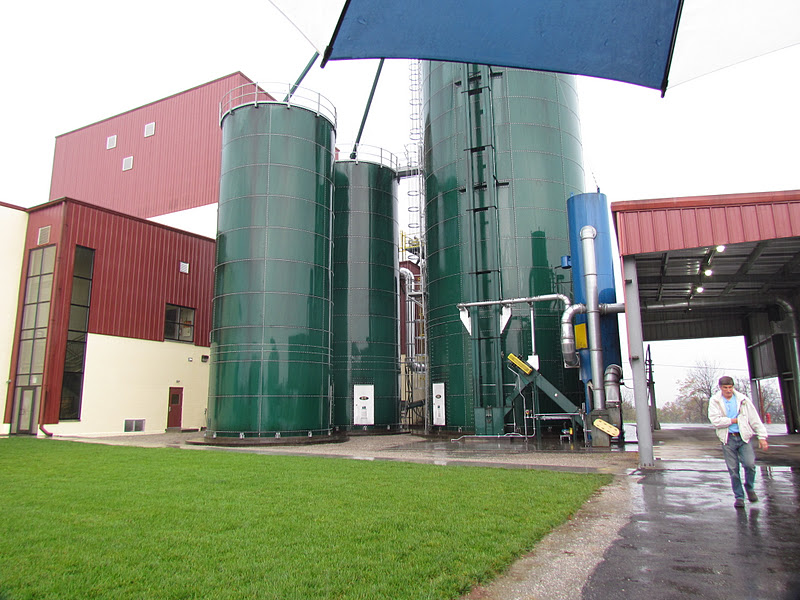
The first thing we saw were these silos, loaded with corn, rye and malted barley. The Wild Turkey formula calls for a majority of the mash to be made out of corn that is grown nearby. They import rye from Canada and the barley comes from Montana or the Dakotas. The barley is shipped to Minneapolis first where it is malted (moistened enough to sprout it, then air-dried, thereby activating the enzymes the grain that enable it to break down into sugars).
The first step in the process is to heat the grain and water together in the cookers --
The warm mash is then loaded into huge fermenter tanks along with yeast --
The mash ferments for three days --
Looking down into one of the almost emptied tanks. It will be steam-cleaned before being filled again --
While we were watching, another tank began to be filled with warm mash --
The fermented liquid then goes to the still where the alcohol is distilled off. The grain particles (slop) that are left behind are given to local farmers for their pigs and cattle (they have a waiting list of farmers...) --
The liquid is distilled a second time and then put into new charred oak barrels where it will stay for the next six to eighteen years. Since we were on the last tour we didn't get a chance to watch the barrelling process as they were finished for the day.
We took the bus back to the Tasting Room where our guide poured us samples of the Wild Turkey products. You could pick two of the seven to try. One is a rye whiskey (where rye is the dominant grain instead of corn) while the others are variations of Bourbon with different ages blended and different proofs --
From there to the Gift Shop where, of course, all of their products are for sale. Forry had a heck of a time trying to decide what he wanted...
The Wild Turkey grounds take up fifty-five acres next to the Kentucky River (where they get the limestone filtered water for their bourbon). Much of the land is taken up by these huge bonded warehouses where the barrels are stored for five to eighteen years. The windows are open during the hot Kentucky summers and the bourbon expands into the charred oak. In the winter as it gets cold, the windows are closed and the bourbon contracts back. This expansion and contracture in the barrels is what gives the Bourbon its characteristic color and flavor.
We arrived in time for the last tour of the afternoon. Our guide loaded us up into a bus and took us across the road and up the hill to the distillery --
The first thing we saw were these silos, loaded with corn, rye and malted barley. The Wild Turkey formula calls for a majority of the mash to be made out of corn that is grown nearby. They import rye from Canada and the barley comes from Montana or the Dakotas. The barley is shipped to Minneapolis first where it is malted (moistened enough to sprout it, then air-dried, thereby activating the enzymes the grain that enable it to break down into sugars).
The first step in the process is to heat the grain and water together in the cookers --
The warm mash is then loaded into huge fermenter tanks along with yeast --
The mash ferments for three days --
Looking down into one of the almost emptied tanks. It will be steam-cleaned before being filled again --
While we were watching, another tank began to be filled with warm mash --
The fermented liquid then goes to the still where the alcohol is distilled off. The grain particles (slop) that are left behind are given to local farmers for their pigs and cattle (they have a waiting list of farmers...) --
The liquid is distilled a second time and then put into new charred oak barrels where it will stay for the next six to eighteen years. Since we were on the last tour we didn't get a chance to watch the barrelling process as they were finished for the day.
We took the bus back to the Tasting Room where our guide poured us samples of the Wild Turkey products. You could pick two of the seven to try. One is a rye whiskey (where rye is the dominant grain instead of corn) while the others are variations of Bourbon with different ages blended and different proofs --
From there to the Gift Shop where, of course, all of their products are for sale. Forry had a heck of a time trying to decide what he wanted...
The Wild Turkey grounds take up fifty-five acres next to the Kentucky River (where they get the limestone filtered water for their bourbon). Much of the land is taken up by these huge bonded warehouses where the barrels are stored for five to eighteen years. The windows are open during the hot Kentucky summers and the bourbon expands into the charred oak. In the winter as it gets cold, the windows are closed and the bourbon contracts back. This expansion and contracture in the barrels is what gives the Bourbon its characteristic color and flavor.
Monday, October 24, 2011
Baseball and Horses -- TWO of My Favorite Things!
We couldn't be in Louisville, Kentucky, without going to visit the factory that makes baseball bats -- the Louisville Slugger! The factory -- and museum -- is right downtown on Main Street, not too far from the Ohio River.
It's easy to spot -- all you have to do is look for this gigantic baseball bat! It's actually made of steel and stands 120 feet high (see how small Forry is beside it?).
Unfortunately, they don't allow you to take pictures during the tour of the factory. I took this one from a mannequin display of the original factory (which began as a factory for making butter churns).
The bats are made out of either ash or maple, grown in upstate New York or northeast Pennsylvania. Today they were making the bats for Game 7 of the World Series (just in case it goes to that many games!). Everyone on the factory tour was given a miniature baseball bat as a souvenir!
In the corner of the building is a neat store where you can buy an actual personalized Louisville Slugger bat just like the ones the big leaguers use. I decided to buy a personalized bat with the Seattle Mariners logo on it. We went to see a short movie, The Heart of the Game, during the twenty minutes it took them to personalize the bat. When I took the bat out of the box to show Forry, I realized they had made it with a Florida Marlins logo instead of the Mariners! I took it back to the counter and they realized it was their error and offered to redo it while I waited. BUT, they couldn't find any more Mariners bats made up! The young clerk said they had had a couple of big tours of Westerners during the last week.
Then they offered to ship it once the factory produced more Mariner logo bats, said it would be within a couple of weeks. Well, what to do? I agreed, darn, I wanted that bat!
Then while I was re-filling out the order sheet with a mailing address, the guy asked me if there were any of the bats hanging on the wall that I particularly liked (It was a display that had all of the different lacquer colors of the bats, but without the team logos.). I thought he was just making small talk, but when I said I thought the two-toned reddish ones were really neat, he took it down from the wall and proceeded to personalize it for me! He not only gave me that one, but also the one messed up with the Marlins logo (said they would just scrap it if I didn't want it...)! So when the Mariners one gets shipped, I will end up with THREE big league bats! Talk about great customer service!!!
Next we headed to Churchill Downs. It is just off of I-65, on our way back to the KOA --
This bronze statue of the thoroughbred Barbaro is just outside the grounds. (Barbaro was the 2006 Kentucky Derby winner who broke his leg while running the Preakness and fought a valiant battle for survival until he was finally euthanized in 2007.) The way it is mounted, it shows him with all four feet off the ground as he runs --
The Kentucky Derby Museum is located just to the left of the track entryway --
Part of the museum had some actual full-size starting gates. Forry couldn't resist trying them out --
The year and name of every winner of the Kentucky Derby since the first race in 1875 are posted along the buildings in white. A very few are in gold. This is the first of the gold ones, the very first horse to win the Triple Crown, Sir Barton --
A statue of Aristides, the winner of the 1875 race guards the entrance to the paddock area --
Our General Admission to the Museum included viewing the film, The Greatest Race, which is shown in 360 degrees around you in the Great Hall. You sit on stools and keeping turning yourself around to see what's going on around you. The film includes black and white footage from the very earliest races up to the colorful movies of the present day. Our admission also included a 30 minute guided Historic Walking Tour, which actually took us down to the mile-long oval track. It's very sandy feeling with small amounts of clay loam. There are approximately 700 horses in the area barns that work out on the track on a regular basis all year-around.
This is the Winner's Circle where the blanket of roses is draped over the winning horse -- but only the winner of the Kentucky Derby (Other races have another area closer to the grandstand.). The grassy area is the infield where thousands gather to party during the race ($40 admission ticket).
This is looking back up at the famous grandstand with its historic twin towers. Chairs in the bottom "boxes" are plain old metal folding chairs. The seats in "Millionaires Row" are up in the sixth floor on the far sides of the grandstand ($20,000 ticket with a minimum purchase of three years worth).
The Fall racing season starts next month with the Breeder's Cup. The writing along the balconies is advertising the sponsor, Emirates Airlines.
We drove back to Sheperdsville to an excellent -- but hole-in-the-wall -- Mexican restaurant we found on Urban Spoon, an iPhone app recommended to me by my friend Leslie. We had their steak frijoles plate for two. We both worked on it, but still had enough left to bring home for lunch tomorrow.
It's easy to spot -- all you have to do is look for this gigantic baseball bat! It's actually made of steel and stands 120 feet high (see how small Forry is beside it?).
Unfortunately, they don't allow you to take pictures during the tour of the factory. I took this one from a mannequin display of the original factory (which began as a factory for making butter churns).
The bats are made out of either ash or maple, grown in upstate New York or northeast Pennsylvania. Today they were making the bats for Game 7 of the World Series (just in case it goes to that many games!). Everyone on the factory tour was given a miniature baseball bat as a souvenir!
In the corner of the building is a neat store where you can buy an actual personalized Louisville Slugger bat just like the ones the big leaguers use. I decided to buy a personalized bat with the Seattle Mariners logo on it. We went to see a short movie, The Heart of the Game, during the twenty minutes it took them to personalize the bat. When I took the bat out of the box to show Forry, I realized they had made it with a Florida Marlins logo instead of the Mariners! I took it back to the counter and they realized it was their error and offered to redo it while I waited. BUT, they couldn't find any more Mariners bats made up! The young clerk said they had had a couple of big tours of Westerners during the last week.
Then they offered to ship it once the factory produced more Mariner logo bats, said it would be within a couple of weeks. Well, what to do? I agreed, darn, I wanted that bat!
Then while I was re-filling out the order sheet with a mailing address, the guy asked me if there were any of the bats hanging on the wall that I particularly liked (It was a display that had all of the different lacquer colors of the bats, but without the team logos.). I thought he was just making small talk, but when I said I thought the two-toned reddish ones were really neat, he took it down from the wall and proceeded to personalize it for me! He not only gave me that one, but also the one messed up with the Marlins logo (said they would just scrap it if I didn't want it...)! So when the Mariners one gets shipped, I will end up with THREE big league bats! Talk about great customer service!!!
Next we headed to Churchill Downs. It is just off of I-65, on our way back to the KOA --
This bronze statue of the thoroughbred Barbaro is just outside the grounds. (Barbaro was the 2006 Kentucky Derby winner who broke his leg while running the Preakness and fought a valiant battle for survival until he was finally euthanized in 2007.) The way it is mounted, it shows him with all four feet off the ground as he runs --
The Kentucky Derby Museum is located just to the left of the track entryway --
Part of the museum had some actual full-size starting gates. Forry couldn't resist trying them out --
The year and name of every winner of the Kentucky Derby since the first race in 1875 are posted along the buildings in white. A very few are in gold. This is the first of the gold ones, the very first horse to win the Triple Crown, Sir Barton --
A statue of Aristides, the winner of the 1875 race guards the entrance to the paddock area --
Our General Admission to the Museum included viewing the film, The Greatest Race, which is shown in 360 degrees around you in the Great Hall. You sit on stools and keeping turning yourself around to see what's going on around you. The film includes black and white footage from the very earliest races up to the colorful movies of the present day. Our admission also included a 30 minute guided Historic Walking Tour, which actually took us down to the mile-long oval track. It's very sandy feeling with small amounts of clay loam. There are approximately 700 horses in the area barns that work out on the track on a regular basis all year-around.
This is the Winner's Circle where the blanket of roses is draped over the winning horse -- but only the winner of the Kentucky Derby (Other races have another area closer to the grandstand.). The grassy area is the infield where thousands gather to party during the race ($40 admission ticket).
This is looking back up at the famous grandstand with its historic twin towers. Chairs in the bottom "boxes" are plain old metal folding chairs. The seats in "Millionaires Row" are up in the sixth floor on the far sides of the grandstand ($20,000 ticket with a minimum purchase of three years worth).
The Fall racing season starts next month with the Breeder's Cup. The writing along the balconies is advertising the sponsor, Emirates Airlines.
We drove back to Sheperdsville to an excellent -- but hole-in-the-wall -- Mexican restaurant we found on Urban Spoon, an iPhone app recommended to me by my friend Leslie. We had their steak frijoles plate for two. We both worked on it, but still had enough left to bring home for lunch tomorrow.
Subscribe to:
Posts (Atom)